
You are here
A Conversation with Karl Gercens III, the Featured Speaker at Our Upcoming Winter Lecture
A Conversation with Karl Gercens III, the Featured Speaker at Our Upcoming Winter Lecture
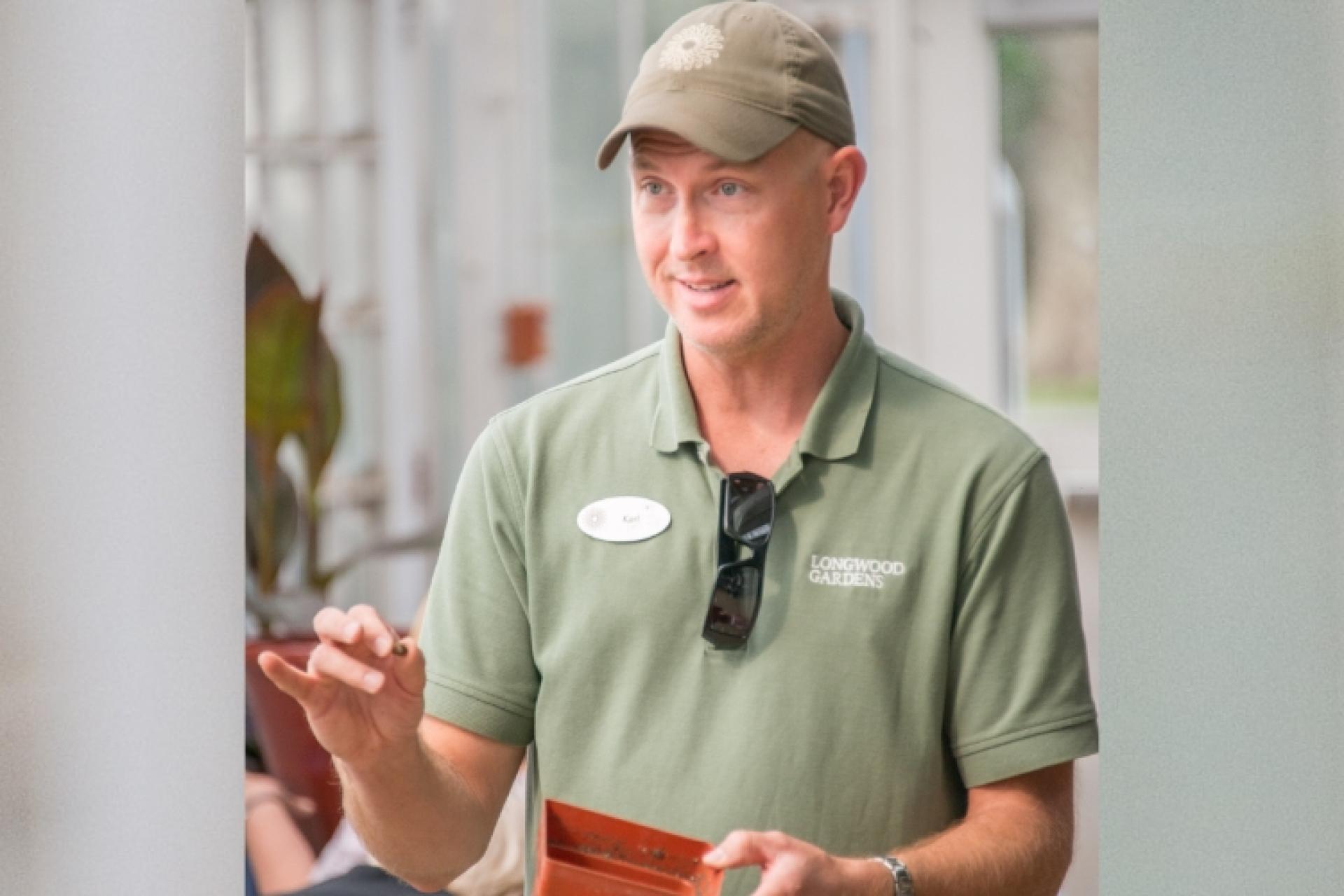

This February, winter will give way to color, at least for an afternoon, when celebrated horticulturist Karl Gercens III takes the stage at the 29th annual Winter Lecture on Saturday, Feb. 21, from 2 to 4 p.m., at Lenox Memorial Middle and High School, in Lenox, Mass. His talk, titled “How’s the Wow,” promises to be as vivid and dynamic as the gardens he designs at Longwood Gardens in Kennett Square, Pa., where he serves as section gardener of the Historic Main Conservatory.
Renowned for his fearless use of color and his eye for the extraordinary, Gercens has spent his career transforming the ordinary into the astonishing. Raised on a 10,000-acre cotton plantation in Mississippi, he grew up surrounded by endless sky and growing things, a childhood that shaped his fascination with nature’s palette and the power of horticultural imagination.
Now, at Longwood, where more than a million visitors flock each year, Gercens curates vibrant seasonal displays that turn the conservatory’s four acres under glass into a kaleidoscope of horticultural wonder. For Gercens, gardening isn’t just about beauty; it’s about that elusive moment of surprise and delight he calls the “wow.”
Defining the “Wow” Factor
“‘Wow’ is the most popular word that we get at Longwood,” Gercens says. “What is that wow factor in the garden? I think that’s going to be size, quantity and the uniqueness.”
He doesn’t mean that metaphorically. “Currently we have this giant chrysanthemum, 12 feet tall, 13 feet wide,” he explains. “You would typically have to go to Japan to see that. In March, we’re going to have blue poppies. You have to go to Vermont, if not even further north, to see something like that. So every single month we have something that will wow you.”
Even the “ordinary” moments at Longwood come with a dose of spectacle. “When it comes to tulips, 300,000 of them outdoors,” he says. “When it comes to spring bulbs, millions of them.”
And while many visitors dream of recreating what they see, Gercens admits he’s not interested in the attainable. “I’ve spoken to many people who want to go to gardens they can relate to or duplicate,” he says. “I’m the complete opposite. I literally want to see something that is unachievable, something beyond my comprehension.”
Color as Emotion
That sense of awe is fueled by color, vivid, unapologetic, emotional color. “I am a red, yellow, orange, purple kind of guy,” Gercens says. “I am definitely not a blue and green. I feel that gardens are exciting, that plant choices are exciting. Therefore, when I’m creating a color combination, I want it to be exciting.”
He laughs at the idea of calm or minimalist gardens. “When I speak to other people and they talk about, ‘Oh, how relaxing this garden is and how calm,’ I’m like, ‘Where are you coming from?’ Because that is not what I’m doing. So I’ve sometimes been called the horticultural hummingbird: attracted to red and constantly going from one thing to the next, never sitting still.”
For those intimidated by color’s complexity, Gercens has simple advice: Let go of the fear. “One of my favorite lines is, nothing is wrong until you get caught,” he says with a laugh. “So I say run and do what you want. Color is temporary. It’s not permanent, so I don’t have any fear of color whatsoever.”
That boldness, he says, might run in the family. “My grandmother painted her kitchen cabinets canary yellow. Each room in my house is a different color: red living room, yellow bedroom, green kitchen, blue bathroom, teal laundry room. I just have color all around me. I don’t think there are too many choices or any rules.”
As for white? “Someone years ago said that white punches a hole in the garden,” he says. “I like that. You’ll use white if you don’t know what else to do. It’s literally the safest. It’s not even color. It’s just boring. It’s a waste of space, a waste of time,” he says, laughing at his own audacity. “I’m being far too opinionated.”
Making It Work
Of course, even at Longwood, perfection is an illusion. “The truth is, we’re real people dealing with real plants with real problems,” he says. “We come up with incredible designs that are near perfect, and then they are subjected to life. Life could be a budgetary concern, a plant failure, a labor shortage, or someone above me just doesn’t like that color.”
Flexibility, he says, is as essential as inspiration. “Every time you see what we got at Longwood, it may only be 70 percent of what we wanted, yet it’s turned out incredible. I have a T-shirt that says, ‘Make it work.’ That’s what I live by.”
The Living Conservatory
Managing Longwood’s Historic Main Conservatory is both an honor and a challenge. “Fortunately, we have multiple different gardens under glass,” Gercens explains. “We can have warm orchids, or a cool Mediterranean climate, or a temperate spring garden. It can be very chilly if we have bulbs.”
That variability brings its own set of horticultural puzzles. Such as?
“We have an expectation that it’s going to be always in flower,” he says.
But Gercens is challenging that expectation. “Beauty is not really just a flower,” he says. “Beauty is not really just a flower, but perhaps beauty is color. And color, of course, comes to us through foliage as well, and foliage is not always green. And in fact, in my life, foliage is never green. Foliage is always red, gold, silver, variegated. And if the foliage has to be green, it better be fastigiate, or it better be weeping. It better be crinkled or rotund. I want, when I look at a plant, to be like, ‘I know why you're here.’ I don't want to glance over and be like, ‘How did you get here?’ While I didn’t create this line, I absolutely believe it that ‘flowers are fleeting, but foliage is forever.’ I’m trying to change the world, one foliage plant at a time.”
Roots and Discovery
His passion for experimentation began early. “I didn’t have any mentors growing up,” he recalls. “My grandparents grew vegetables and collected roses and daylilies and irises. I just played. I ordered plants online, tried them, failed, tried something different. I grew what liked me; it wasn’t ‘I grew what I liked.’ Find the plant that works for your conditions. So much easier that way.”
His curiosity took him far beyond Mississippi. Internships at Walt Disney World and the Filoli Estate in California exposed him to a world of horticultural diversity. “I’ll tell people Disney World is my favorite garden,” he says. “Why? There’s architecture galore, incredible plants, everything is well maintained, and it invites conversation. Each theme park feels different. It’s a world of discovery.”
And that’s where Gercens learned perhaps his most lasting lesson. “Working at Disney blew the doors off my world,” he recalls. “I met people from other countries, other backgrounds. It made me realize I had so much to learn. Since then, I’ve just been the most curious person I can be. That was 30 years ago, and I’ve not slowed down.”
The Future in Living Color
Looking ahead, Gercens sees color — and access — as the future of horticulture. “If I’m going to use my land, it’s going to be for a plant that’s truly exciting: visual, tactile, maybe fragrant, but mostly visual. These days, especially with social media, if you can’t Instagram it, then why are you doing it?”
He laughs, but the point is serious: Beauty is how people connect to plants. Education can then follow.
“People have called me out as a person with a variegated foliage addiction,” he says. “I’ve been a fierce proponent of colored foliage my entire career. Twenty-five years ago, you had to go to a specialty nursery to find these plants. Now you can go to a big box store. I’ll drive down the street and think, ‘That was a rare plant 20 years ago, and now it’s everywhere.’ And I love it. I’m not a plant snob. I just appreciate seeing a beautiful plant, no matter where I go.”
The 29th Winter Lecture: “How’s the Wow” with Karl Gercens III
Saturday, Feb. 21, 2 p.m.
Register here.
Help Our Garden Grow!
Your donation helps us to educate and inspire visitors of all ages on the art and science of gardening and the preservation of our environment.
All donations are 100 percent tax deductible.